China - Friend or Foe?
In the shadow of cooperation lies suspicion. India and China trade smiles, but behind the polished gestures are cracks—border clashes, strategic rivalry, and a long-standing partnership with Pakistan. This piece explores why China can be both a friend and a foe, and why India must tread carefully.
ECONOMICS
Afnan Samdani Khan
9/8/20252 min read
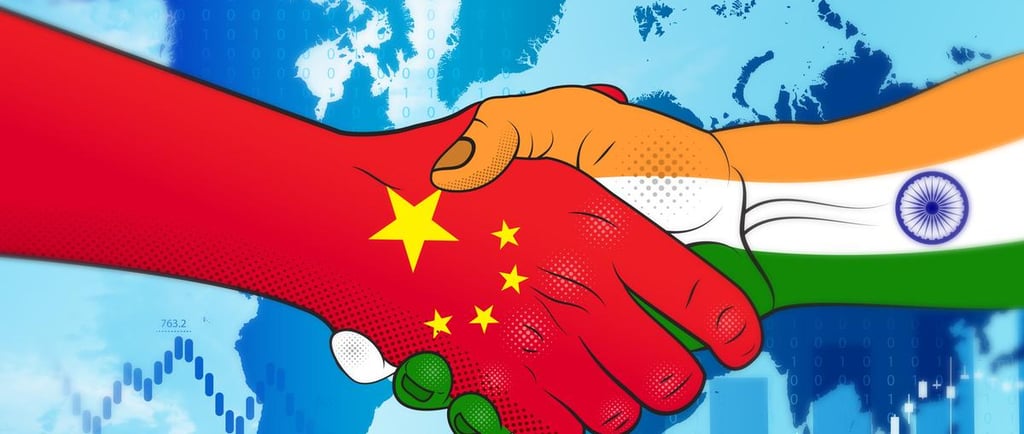
"In the shadow of a common foe, even rivals clasp hands."
The recent wave of U.S. tariffs has pushed two unlikely partners—India and China—into the same fortification. Both are recalibrating their trade strategies to withstand the tremors unleashed by Washington’s policies. For decades, the two Asian giants have remained inseparably relevant to one another; neither can frame its policies without factoring in the other.
The attempts by both nations are becoming increasingly apparent. India’s Prime Minister recently attended the Shanghai Cooperation Organisation (SCO), an alliance established by China in 2001 to promote stability, security, and peace in the region. With India’s ties with the United States facing strains, strengthening trade relations with other partners has become a priority—and the SCO offers New Delhi a fitting platform to pursue that goal.
As for China, its ineffective export-led growth strategy has left it searching for new markets to expand its horizons. In that effort, China’s Foreign Minister, Wang Yi, recently visited India to explore opportunities for closer economic engagement.
Polished surface hides the cracks within. No sooner had Wang Yi concluded his visit to India than he flew to Pakistan, reaffirming Beijing’s time-tested alliance with New Delhi’s arch-rival. From military cooperation to economic ventures like the China-Pakistan Economic Corridor (CPEC), this partnership has consistently undermined India’s strategic space. Adding to the mistrust, China has repeatedly blocked India’s efforts at the United Nations to designate Pakistan-based militants as global terrorists. The message is clear: while China may extend a hand of trade to India, its other hand remains firmly clasped with Pakistan.
However, it is equally noteworthy that China is not just shielding Pakistan but also competing with the United States to claim influence over it, after decades of investment and favors. The recent U.S. tariff structure makes the shift visible—19% for Pakistan compared to 50% for India. Washington’s softer hand toward Islamabad, coupled with Beijing’s long-standing patronage, has placed Pakistan at the center of attention for both superpowers. What was once a one-sided dependence on China has now turned into a contest where Pakistan benefits from the rivalry between two giants.
Trump’s attempts to appease Pakistan—with favorable trade conditions and by inviting Pakistani Army Chief Amir Munir to Washington—marked the moment when cracks began to appear in India–U.S. relations. With both China and the U.S. extending selective favors to Pakistan, India finds itself navigating a complex web of appeasement, where strategic caution is more crucial than ever.
India’s engagement with China is a story of contrasts. On the surface, warm gestures from both sides suggest a picture of strategic partnership—something both nations need in today’s hostile environment. Beneath that polished exterior, however, India must exercise caution when dealing with a neighbor that has repeatedly tested its limits: from the deadly Galwan Valley clash and ongoing skirmishes in Ladakh to incursions into Arunachal Pradesh, China has consistently shown that diplomacy often takes a backseat to strategic assertion.
The question isn’t whether China is friend or foe—it is both. For India, the challenge lies in navigating this duality: to engage China where mutual interests align, yet remain vigilant where strategic rivalry persists. In this delicate balance, caution, foresight, and clear-eyed diplomacy will determine whether India turns these cracks into openings or suffers the consequences of misplaced trust.